


THE SAAR-MOSELLE TRIANGLE
DOORWAY TO TRIER
Fighting east of the Saar River had developed into a bitter slugging match against tenacious
enemy resistance. In the towns of Saarlautern, Fraulautern, Saarlautern Roden, Ensdorf, and Dillingen,
each block became a separate battlefield as tanks roamed up and down the streets looking for targets.
Enemy machine guns were zeroed down every thoroughfare. To gain ground, Corps infantry resorted to
the technique of "mouse-holing", blasting their way through reinforced concrete walls from house-to-
house. They cleared the houses room-by-home only to have the Germans infiltrate back again.
Scattered through the towns and around the surrounding countryside was an almost impenetrable
maze of pillboxes. They were usually dug in flush with the ground with only the turret exposed. In
addition, they were carefully camouflaged with natural growth, and were hard to locate even from the
air. Even when detected, the heavier types were a problem to reduce. Artillery, alone, was rarely
sufficient. One steel turret, encountered during the fighting at Ensdorf, withstood several direct hits
from a 155 mm self-propelled gun and over 50 rounds of 90 mm fire from a tank destroyer. The
pillboxes were placed so as to support each other and lay down a continuous band of fire along all likely
approaches. When Corps assault teams fought their way close to these defenses, the Germans retired
inside and called down their own artillery on the positions.
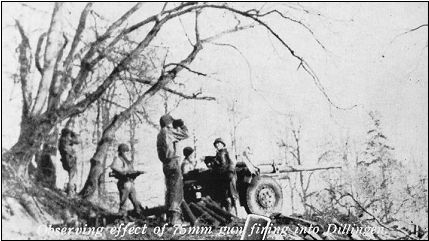
Calls for the close support of Corps artillery were frequent and the fire-happy "red-legs" were
never too cold nor tired to respond to the call of "Fire Mission"!
Many unequal duels were fought at close range between German guns, well protected by several
feet of concrete, and the heavy cannon of Corps artillery, dug into the deep Lorraine mud behind the
doubtful protection of sandbags. On one day alone, over 18,000 rounds were fired against the Germans
by Corps artillery units. German prisoners expressed wonder at Corps "automatic" artillery though
ammunition was restricted and firing was limited accordingly.
When the German defenders were driven deep into their shelters by heavy bombardment, the
infantry-engineer assault teams drove in with small arms fire, fragmentation grenades, and explosive
 |
 |
 |