


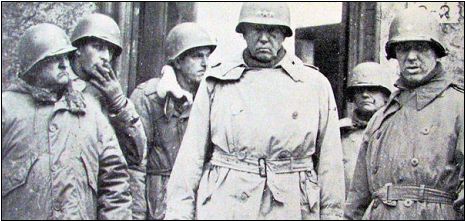
TASK FORCE OF BACON
From left to right foreground: General Walker, General Patton, and General Van Fleet
Commanding General of the 90th Division, who is shown explaining the situation at his
Command Post at Koenigsmacher. In the background are Colonel Harkins, Deputy Chief of
Staff, Third Army; Colonel Codman and Major Stiller, aides to General Patton
While this action was going on in the northern sector of the XX Corps zone, the 95th Division
increased pressure on the west of Metz. The bridgeheads at Thionville and Uckange were expanded
against bitter opposition. Small arms melees at close range were fought frequently, as the enemy
stubbornly resisted this direct threat to the inner defenses of Metz.
A strong blow was being struck against the enemy fortifications in the area around for D'Illange.
The fort was first subjected to a 30 minute barrage by several battalions of XX Corps artillery and then
assaulted by infantry carrying explosive charges of TNT. Final resistance in Fort D'Illange ended during
the morning of November 15th. Another Metz bastion had fallen to the grit and ingenuity of the XX
Corps forces.
The XX Corps Operational Reports sum up the situation: "General Walker had been studying the
situation on the eastern banks of the Moselle and had realized the military potentialities that existed in
the area, particularly since intelligence and battle report showed the enemy had been forced to withdraw
the bulk of his river line units and commit them in the zone of the 90th Infantry Division. Accordingly,
the Corps Commander decided to constitute a mobile striking force. This force would sweep the eastern
banks of the Moselle along with three to four mile zone of advance and attack Metz from the north."
The mission assigned Task Force Bacon was to drive into the outskirts of Metz in three days, sweep
south, clear the east bank of the Moselle, and attack Metz from the north. Speed and firepower were the
attributes of this force. Each town was entered with tank destroyers firing point-blank at all points of
resistance. Two 155 mm self-propelled guns were placed well forward in the column ready for
immediate use against enemy strongholds. On entering towns, marching fire by the infantry and heavy
use of the 90 mm guns of the tank destroyers quickly discouraged snipers and gun crews who either
surrendered or fled. Flank protection was provided by the wide Moselle on the right and elements of the
90th Division on the left.
 |
 |
 |