


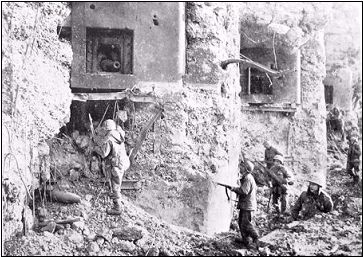
MAGINOT FORTS
Fortifications of the Maginot Line took terrific batterings
but in most cases were still useful.
The terrain approaching the Saar River is undulant, rolling in a series of gentle slopes to a high
plateau and then dropping sharply away to the Saar Basin. The area is laced by the French and German
Nieds and their minor tributaries, and each stream has carved out a well-defined valley. There are
wooded areas and dense forests of tall, straight evergreens, but most of the land is open and carefully
cultivated.
The road net was for the most part a poor one and the systematic blowing of the bridges and
culverts along the roads made matters worse. The situation was especially bad because almost all
movement of vehicles was canalized along the narrow roads.
The Maginot Line stood between the Saar and the Moselle. Situated on commanding ground,
these ponderous forts, although constructed by the eastward-minded French and now manned by a
westward-minded Germans, were still strong enough to serve as a barrier in the path of the XX Corps
offensive.
The Corps Commander decided to take the most direct route through the enemy held territory
between the Moselle and Saar, and ordered the 90th Division into an assembly area near the Nied River
on the 24th of November. Movement of the Division eastward from the assembly area was slowed by
roadblocks, mines, and blown bridges, but by nightfall of the same day some infantry troops had entered
Germany and were approaching the Saar. Observation posts were set up overlooking the river.
The 95th Division pushed on to Niedervisse and Denting where a hospital filled with over 1,300
seriously ill Russian prisoners of war was captured. As the advance continued on the 29th of November,
the enemy resisted stubbornly and fought savagely for every foot of ground. Resistance became
particularly bitter on the high plateau that looks down on Saarlautern in the Valley of the Saar and on the
Siegfried defenses beyond. Heavy artillery fire from east of the river and counterattacks, spearheaded
by tanks of the 21st Panzer Division, made the going slow and costly. One German division facing the
 |
 |
 |