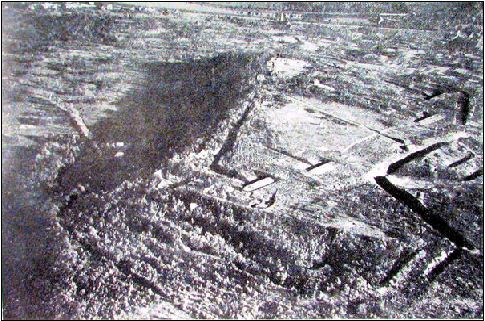
ATTACK ON FORT DRIANT
Aerial view of Fort Driant with the Moselle River in background. Zig-zag shadows represent
Tank obstacles. On the left are barracks on which troops climbed to find ventilators.
About 5 miles southwest of Metz, just west of the Moselle River, stood Fort Driant, one of the
strongest in the band of forts. During the September operations across the river south of Metz, this great
rampart of steel and reinforced concrete with its batteries of huge guns was a thorn in the side of XX
Corps. From its commanding position, it could turn on a speedy curtain of fire down the Moselle Valley
and hamper any advance. Fort Driant was, accordingly, considered a keystone in the Metz fortified
region and its reduction was thought to be a necessary prelude to a successful tank attack up the Moselle
Valley toward Metz. In addition, after the severe fighting along the Moselle River line, a successful
assault on one of Metz’ great bastions would serve as a morale booster for the troops of XX Corps.
For these reasons, and to gain first-hand experience in the reduction of such fortified bulwarks,
an attack by the elements of the 5th Division was endorsed by XX Corps and the Third Army.
Very little definite information on Fort Driant could be obtained, but it was believed to be
defended by at least three companies of elite troops and several batteries of heavy guns.
After a bombing run by P-47s and an artillery preparation an attack was launched on September
27th to probe out the defenses. The assault echelon ran into interlacing bands of machine-gun fire laid
along a huge moat 20 yards wide and 30 feet deep. The casemates and concrete shelters had walls seven
feet thick and were so located as to command all likely approaches. Wire and belts 20 feet wide
surrounded these barriers and heavy accurate artillery and mortar fire was delivered from the