


Thionville Captured
The enemy fought a withdrawing action as he was pushed back through Fontoy,
Hayange, and Marspich to the Moselle River. To the Second Battalion fell the task of capturing
Thionville, an industrial city on the banks of the Moselle. House to house, door to door fighting
took place in the town as the enemy was made to relinquish his threshold on the formidable river
barrier. Withdrawing during the night he destroyed the last remaining bridge over the river. On
the following day the First Battalion was sent in to mop up the north half of the city and together
with the Second cleaned it out to the west bank of the Moselle.
Fort Driant
The Third Battalion was transported south along the Moselle, near the renowned fortress
city of Metz, to St Marie Aux Chenes. They were followed in a few days by the rest of the
Regiment. They took up the defensive position opposite the gates of Metz, facing the historic
forts of Fort Driant, Jeanne d’Arc and the so-called Verdun group of Forts. This defensive
position was maintained throughout the month of October. During this period, some of the men
left the muddy banks of the Moselle for a few days to rest and cleanup in an improvised rest
center at St Marie Aux Chenes. The Paris pass policy was instituted in the Regiment at this time
and some fortunate officers and enlisted men visited “Gay Paree” for the first time.
Early morning on the first day of November began an epic that will long be remembered,
it saw the front line battalions slip out from under the eyes of Fort Driant and the other mighty
forts to move to a concentration area near Morfontaine, France. Election day in the United States
found the 358th Infantry embarking on a momentous military operation – an assault crossing of
the Moselle River.
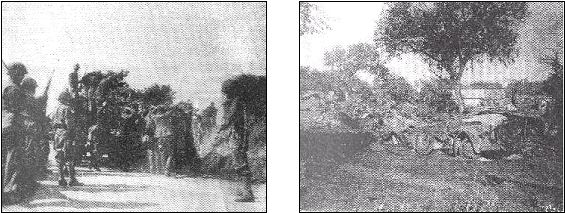
A load of PW’s near Le Mans
Smashed German equipment
in the Falaise Gap
 |
 |
 |