


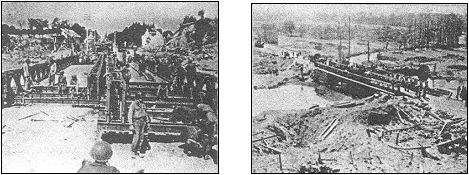
Again, the supporting corps engineers moved in to construct heavy rafts and a bridge but, as at
the Moselle, the flooded river, smoke dissipating winds and deadly accurate fire blocked every effort.
Bridges were started and rafts constructed but the accurate fire knocked out each one. The infantry
fought to capture then recapture the pill-boxes of Dilligen and Pachten and the 315th brought over
welding equipment to seal embrasures of the captured forts.
All supplies were carried across in boats at night and the wounded were brought back on return
trips. At a site between the two on which the enemy had been placing such accurate fire, a ferry was
finally put in operation and a trickle of armor and tactical vehicles began to cross. The trickle continued
and on the 15th armor supported infantry stormed and took Dilligen.
Then Suddenly the picture changed. To the north the Von Ronstadt offensive had broken through
the American lines in Belgium and Luxembourg.
Engineers of the 315th began installing mines and booby traps in Dillingen as preparations were
made for the evacuation of the 90th’s Saar bridgehead. On the 19th Company A built a footbridge near
Buren and the withdrawal began. For three days and nights the operation continued and under
continuous shelling all troops and all except six destroyed vehicles were withdrawn by ferry, foot-
bridge; and assault boat and so the "double-crossing" of the Saar was completed. The Siegfried Line had
been cracked and another triumph was almost achieved but the fortunes of war demanded that the 90th
move elsewhere.
Christmas of 1944 was spent in the Maginot Line area near Veckring. Here the 315th was
deliberately preparing a defensive zone along the front of the Siegfried switch position from Sierck-les
Bains through Manderen, Launstroff and Waldwisse to Mondorf. Bridges were prepared for demolition,
craters were charged, trees were fixed for easy felling across roads and mines were emplaced. But the
90th could not long be spared for a defensive mission and on 5 January orders were received – "be
prepared for movement".
Figure 6-1
Figure 6-2
 |
 |
 |