THE BATTLE OF CENTRAL EUROPE
Cleaning
out the west bank of the MOSELLE was an easy task, although C Co. ran into a
hot spot at LOF. For one month the
Boche had been unable to use defensive terrain positions and had only resisted
locally – from town to town. Reaching
the broad MOSELLE at HATZENPORT and MOSELKERN, where contact was made with the
5th Inf., the tankers speculated on whether the Boche had the power and the
will to use this natural barrier effectively.
The orders were to cross, advance southeast and seize a bridgehead
across the NAHE RIVER between BAD KREUZNACH and BINGEN. If the past three weeks were any indication,
then all that would be met would be snipers, roadblocks and occasionally a nest
of fanatics. On 14 March the doughs
went across, meeting at the outset very little opposition. But there were still Heines with some will
to win and the 1211th Regt. of the 159th VG Div. struck the 359th at
MORSHAUSEN. The situation became tense,
but B Co. tanks, crossing by ferry, rushed up and quickly routed the
attackers. The engineers, working this
time in comparative ease, soon had a pontoon bridge up and the rest of the
tanks, under cover of darkness but assisted by the newly developed artificial
moonlight, debouched across to join their respective regiments. What little enemy forces there were facing A
and B Cos. on the Division's right flank quickly collapsed and again the tanks,
loaded with doughs, were dashing from town to town. But on the left, where C Co. and 357 were, it was another
story. The 6th SS Mountain Division had
decided to hold PFAFFENHECK and were making the tankers and doughs pay a heavy
price. PFAFFENHECK and the neighboring
BUCHOLZ were not cleared until 16 March, at which time C Co. tanks, taking the
initiative and working with masterly skill, stormed the positions and seized as
booty forty-eight 20 mm., four 40 mm. and eight 88 mm. guns.
Meanwhile
on 15 March “Patton's Famous Fourth Armored” passed through the Division's
bridgehead and, with B Co. and 359 attached, began to cut swathes in the German
ranks, assisted by XIX Tactical Air Command which took advantage of the first
rainless days in March. The Boche was
scurrying east to the RHINE and all American units were extending themselves to
prevent any wholesale escape across that mighty river. The 87th Inf. had crossed the MOSELLE in the
north and turned northeast toward COBLENZ.
The 4th Armd. had encircled BAD KREUZNACH, which B Co. and 359 mopped
up. On 17 March Task Force Speiss went
on a rampage, accepted the surrender of ST. GOAR, reached the RHINE and fired
across it into retreating columns. And
on the next day with A Co. and 358 it cleaned out all territory east of the
NAHE and south of BINGEN. 19 March
found A Co. with 358 and B Co. with 359 – now back under Division control –
fording across the NAHE. They carved a
bridgehead 6 miles deep, only mildly hampered by scattered flurries of the
limping Luftwaffe. Then Task Force
Speiss, broken down into three components – Task Forces Wagnon, Dye and Kelly –
broke loose again, making a 10 mile plunge in 6 hours and meeting only spotty
resistance, with Task Force Wagnon hauling in 500 prisoners in one day. On 20 March this Task Force was sent to block
and protect the southeastern flank which had become exposed by a widening gap
as the 4th Armd. moved southeast toward WORMS and the 90th northeast toward
MAINZ. On this same day A and B Cos.
ran into snags, the danger of which was always present. While the perils of fighting were greatly
reduced from what they had been in previous campaigns, death still lurked at
every roadblock and every once in a while a savage clash would flare up. A Co. hit one of these at OBER INGELHEIM,
while B Co. had to hit with both fists at EBERSHEIM; in both instances,
however, the 712th-90th team was much too proficient and daring for the cluster
of fanatics. The Luftwaffe made an
appearance this day, flying 44 seemingly aimless sorties with jet propelled, FW
190 and ME 109 planes. And that night
some audacious prowling Nazis hit an A Co. platoon bivouac area and were thrown
back only after a fierce fight during which one Boche managed to heave a hand
grenade down the barrel of a Sherman, inflicting painful injuries on the
occupant.
On
21 March the tankers and doughs began converging on MAINZ. A Co. with 358 struck from the north, B Co.
with 359 hit in the center, and Task Force Speiss blocked on the right
flank. The Boche evidently planned to
make a real stand as all units bumped into particularly stout resistance in the
suburbs and were once again embroiled in savage conflict. Big Kraut guns from the other side of the
RHINE threw heavy barrages at the advancing American columns. But persistence and resolution told and by
nightfall the team was ready to move in on the city the following morning. The attack began as scheduled in a perfectly
coordinated assault. For the Germans it
was a sorry day. Proud MAINZ was
falling and falling fast in spite of repeated assertions that the city would be
defended to the last man and to the last round of ammunition. For the Americans, after the all-out
house-to-house defense of the suburbs, the ease with which the city itself was
taken was an anti-climax. Neither
threats nor pleadings could evoke the will to resist in more than a handful of
the miscellany who were the city’s defenders.
A feeling of hopelessness pervaded this one time capital city. Its heart was gone with its buildings for Allied
bombers had done their work well. Now
the civilians huddled for the last time in their underground shelters. Braver ones on the streets watched
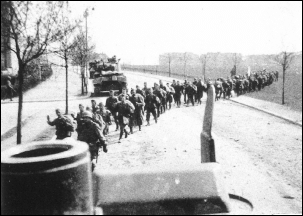
apathetically as their soldiers surrendered by the hundreds. There was fighting – on the outer edges and
in the green parks. But the Citadel,
moss-covered underground fortress defiantly barring the south entrance, was
taken without fanfare, and when the railroad tracks which bound the city’s
girth were crossed, resistance became sporadic, confined to small groups of
die-hards. Finally it stopped
altogether. The City’s radio station was
taken intact and Col. Weiss, the Commandant, surrendered. By nightfall the city of MAINZ was added to
the already impressive group of scalps taken by the 712th-90th team. Meanwhile C Co. with 357, assigned the job
of cleaning out the west bank of the RHINE, ran into a hornet’s nest at WEISAU
which they overcame only after a furious assault.
Further
north American Arms were pouring across the RHINE on the REMANGEN BRIDGE but in
the 3rd Army sector no bridge had been captured and an assault crossing was
necessary. The 90th was originally
ordered to create a diversionary feint around MAINZ, while the real crossing
would be effected by the 5th Inf., further south. All proposed plans indicated that for the next several days the
tankers would only be required to roll their tanks around and perhaps fire
across the river. But at 0925 23 March
Division received the following order: “Assemble 2 Regts. in reserve at once
prepared to cross RHINE tonight.” The 5th Inf. had crossed with ease and no
time was wasted in exploiting the situation.
As the tanks rushed down to DEXHEIM, where the crossing was made,
changes in orders flooded in. The 80th
Inf, was to relieve the 90th and now it would not arrive and the 26th Inf.,
itself not even relieved in the south, would take the 90th’s positions. The high command was hard put to adjust
itself to the ease with which the once mighty barrier had been surmounted.
C
Co., with 357, was attached to the 5th Inf. and as soon as they crossed were
embroiled with the 112th Regt. of the 553rd Div. at ERFELDEN and with 120
FRANKFURT policemen near LEITHUM.
Fighting became so intense and the lines so confused that two C Co.
tankers were just about to leave one building after a conference when they
discovered a Heine guard posted outside the building. But soon the situation was under control. Meanwhile B Co., and then A Co., had crossed
and were making steady, slashing gains, despite an occasional JU 88 and ME
109. Sufficient ground was quickly
cleared – the hole had been opened – to permit the 4th Armd. to uncoil and
again that outfit moved through to commence its dash to the MAIN RIVER. The 90th was off in its wake and 25 March
was a day of rapid overrunning of much ground.
All three medium Cos. sliced across a major autobahn and reached out way
past their initial objectives, while the light tanks, with Task Force Speiss,
had the honor of seizing industrially important DARMSTADT, moving in from the
west as the 4th Armd. surged by on the east.
With the 6th Armd. on the left or west, the 90th in the center, and the
4th Armd. on the right the area between the RHINE and the MAIN was quickly
contained and only minor resistance met – A Co. at DIETZENBACH, B Co. at
SPRENDLINGEN and D Co. at OFFENTHAL. By
27 March all the south side of the MAIN had been cleared and the tankers
watched the Heines attempting to construct entrenchments on the north side
while the Long Toms blasted at them. 6
or 7 less fanatical Hitlerites climbed into a rowboat and rowed across to
surrender.
The
MAIN crossing, spearheaded by the 90th in the vicinity of DOERNIGHEIM west of
HANAU and east of FRANKFORT, was contested by the Boche much more bitterly than
he had the RHINE. A Battalion of Hitler
youth, led by veteran NCO instructors from an OCS in the neighborhood, were not
dismayed by the overwhelming advance of Allied Armies on all fronts, and they
made a stand for it. But their lines
were spread too thinly and they were no match for the best functioning, most
experienced tank-infantry team in the ETO.
The doughs crossed at 0300 28 March and soon were joined by the
Shermans. By the day’s end a 400 yard
water barrier lay behind, with a firm 5 to 6 mile bridgehead established to
cover the debouchments of the 4th and 6th Armds., and the OCS Battalion had been
badly bloodied. The remaining days of
March were marked by rapid progress in all sectors, as the 712th and 90th sped
through the white flagged towns of the Hills of Hessen, with B Co., again
attached to the 4th Armd., running into the only thing that amounted to major
resistance at SELTERS, where a section of tanks were surprised by several
Panzerfaustmen. And by the end of March
the units were 250 miles inside Germany.
They had swept past incalculable enemy material, rounded up many more
thousands of prisoners, and were ready to strike clear across the “Fatherland”
into Czechoslovakia.
When
April commenced the 712th and 90th were driving lancets through the HESSE
CORRIDOR, mopping up behind the 4th Armd., as well as conquering ground on
their own. On the right in XII Corps
sector the 11th Armd. and 26th Inf. were making similar gains. Lines were stretched to the utmost and on 1
April the disquieting information came that sizeable enemy forces had cut
across the axis of communication to the rear, blocked the Main Supply Route
north of HOCHSTADT, and were harassing and ambushing supply vehicles. Seven Serv. Co. trucks left NIEDERAULA for
gas and were set upon near WALLERNHAUSEN.
A stiff fight ensued with the Serv. Co. boys, ill-equipped to combat such
tactics but resolute in their desires to keep the tanks supplied – a job they
performed throughout combat with great energy and skill – finally forced to
capitulate, although one truck managed to whee1 about and escape. This confusion and danger in the rear, a
natural incident to long stride advances with extended lines, was shortly
corrected when light tanks were attached to all supply columns, but only after
the 712th Personnel Section, along with the other units in 90th Rear at
OFFENBACH, readied themselves for the attack only to find that a burning
carload of ammo had been the cause of the alarm. And in several days all personnel who had been captured in these
ambushes were once again back at their parent units.
When
the 4th Armd. shifted out of XII Corps the 90th was once again on its own,
fronting the left flank of the Corps drive, with the 11th Armd. on the right
and the 26th and 71st Infs. in the rear.
B Co. and 359, again doing superb work with the 4th Armd remained with
that spectacular Division until 4 April.
They showed their mettle at MADELUNGEN where a band of SS Troops
evidently thought that they could stop this experienced team and were soon
outwitted, outfought and whipped. The
crooked, narrow WERRA RIVER now stood in the way of the 90th’s advance and
proved to be a much greater obstacle than had the once feared, mighty RHINE, as
the Boche charged with defending its banks displayed unusual tenacity and
power. C Co. probed a weak spot and
forded across with 357 on 2 Apr.
Striking straight out and with a classic display of marching fire and
teamwork – highlighted by a dough who served ably as an assistant tank gunner –
stormed into DIPPACH. On 3 April they
found a bald ridge near VITZERODA stoutly defended by 100 SS Troops backed by
mortars. The fighting continued from
0930 until dark, when an adroit flanking movement by the tanks completely upset
the Boche and routed him. A Co., with
358, had reached the WERRA on 2 April but found that the railroad bridge they
had seized could only be used for foot-troops.
So on 3 April part of this team forded across behind C Co. and headed
down the far banks of the river, cleaning out many towns. The other part of the team paralleled this
drive on the near banks and all defending forces were quickly dispatched. What was left – some 500 troops armed mainly
with Panzerfausts – holed up in VACHA but were soon hit and whipped by the
onrushing tanks and doughs. This action
by A and C Cos. had effectively ruptured the Boche’s attempt to form a Main Line
of Resistance, and the 712th-90th team had now straddled the WERRA, over which
no American soldier was to have passed.
But that evening the Boche unwittingly dealt a devastating blow. At 1830 one of his planes roared in and was
immediately hit by AA. Limping, it
began a crash dive and apparently jettisoned its bomb load right over A Co. and
358 CPs at HEIMBOLDHAUSEN. One bomb hit
a boxcar of black powder and the resulting terrific explosion left a 50 foot
crater, leveled 5 houses, blew the roofs off 30 others, and broke all windows
in the vicinity. It also left men
pinned under the debris, men with burst eardrums, and in several instances men
who had thus paid the supreme sacrifice.
Out of a total of over 40 men the A Co. Hq. platoon could not muster
even 10 to carry on the next day, and of these two-thirds sported purple
hearts.
All
units moved rapidly forward against dissolving opposition, although C Co. was
compelled to blast a determined SS aggregation out of MARKSUHL. On 4 April A Co., with 358, noticed nothing
unusual as they moved into MERKERS – a salt mine and the usual run of
houses. But some chance remarks by
civilians put intelligence on the scent and in no time at all evidence revealed
that the subterranean chambers of the salt mine contained a gigantic haul of
wealth. Complete unearthing produced
100 tons of gold bullion, 5 billion German Marks, 2 million American Dollars, 4
million Norwegian Pounds, 100 million French Francs, 110,000 English Pounds,
200 painting masterpieces including Raphaels, Rembrandts and Van Dycks, 1500
priceless tapestries, and many other highly valuable works of art. This cache was considered so important that
2 platoons of C Co., 2 Bns. of 357, and 2 platoons of D Co. were used to guard
it for the next 10 days, and those men lucky enough to draw this assignment
watched as such dignitaries as Gen’l. Eisenhower, Gen’l. Bradley and Gen’l.
Patton made inspections.
For
the next 10 days the doughs rode on the tanks seeking the vanishing enemy as
all Allied armies began to carve Germany up into little bits. The end was not far away and tactics were
reduced almost to a formula. Swooping
into the vicinity of a town, the tankers would scout out to see whether the
white flags were flying. If so, the
doughs stayed on as the tanks laid their tracks down the main street. Soon squads of infantry were searching the
houses and the Burgomeister would be announcing at every street corner the
regulations concerning weapons, travel and curfew. Frequently even before this was under way the fast riding team
would be headed toward the next objective.
If however no white flags were flying, then the tank guns would feel out
the enemy by firing 3 or 4 rounds and usually the white flags came up. But sometimes there were SS men, or Hitler
Youth, or even some fanatical Volkstrum, who would resist until overpowered,
more often than not inflicting several casualties with the result that their
town would feel the wrath of the tank guns and small arms. If the town was the day’s objective, the
tankers soon knew how to pick out the best appearing house in the sector they
were to outpost, and in a mixture of English and German issue the following
orders: “Funf soldaten schlafen hier.
Yo nix bleiben hier. Yo bleiben
keller. Rouse und Vech in zwanzlg
minuten.” The house would be taken over, guard set up, and soon the tankers
would be sitting down to a hearty meal in the Heine kitchen.
But
all was not a bed of flowers. Road
blocks were often strongly manned and only eliminated after an assault. The 712th and 90th had the mountainous and
heavily wooded THURINGER WALD, one of the first areas fully dominated by the
Nazi Party. But the team drove along
the roads which had been carved on the mountain sides and chopped through the
thick trees with such skill and power that they soon earned the reputation and
accolade among the Nazis as being “The Forest and Mountain Division.” And more
than ever the tankers became convinced of the justness of their cause and the
depravity of the Nazis, as Allied prisoners were liberated and concentration
camps freed. The feeling of joy
inspired by these emancipations was quickly replaced by anger at the sight of
emaciated bodies and the stories of suffering and cruelty.
By
14 April B Co. with 359, on the left and echeloned back to keep contact with
the slower moving Division in that sector, had swept through GEHREN,
LANGE-WIESSEN and KONIGSEE, and had reached the SAALE RIVER. A Co. with 358 had ridden roughshod through
GROS BREITENBACH, GRAFENTHAL and LOBENSTEIN to the SELBITZ RIVER, and now stood
ready to jump on the key town of HOF in conjunction with D Co. now working with
90th Recon. The offensive of HOF was
perfectly executed and the town fell in a short time and with it 1192
prisoners. The 712th-90th team was now
spearheading the 3rd Army drive and stood poised near the CZECHOSLOVAKIAN
BORDER waiting for orders to move across and cut Germany in two. For several days they merely consolidated
positions and shoved strong reconnaissance patrols forward. These latter elements found that the BORDER
reacted very sensitively, but on 18 April A Co. with 358 went across and thus
became the first American unit to sever Germany across her waist.
The
Division now pivoted right and headed south and southeast along the BORDER,
with the mission of preventing any Heine troops from massing in the REDOUBT
AREA – the mountainous region surrounding BERCHESTGADEN. A Co. with 358 on the sensitive left flank
pounded southward seizing SELB, SCHONWALD and ROTHENBACH on 20 April, and on 23
April pounced on the huge death factory at FLOSSENBERG, finding some 1160 of
the original 16,000 inmates. C Co. with
357 maintained the same lightning pace, running into some resistance from Heine
half-tracks at HEBANZ on 19 April and being delayed for a short while at
POPPENREUTH on 20 April. On 24 April C
Co. tanks led the doughs and TDs in a brilliant stab to seize the bridge at
BURGTRESWITZ before the enemy could blow it.
Surging around a corner the tanks were suddenly faced by 5 Panzerfaustmen
and a sharp, bloody engagement resulted, with the tanks taking the honors. Still intent on their mission the C Co.
tankers rushed on and seized the bridge.
D Co. still working with 90th Recon. swept into FUCHSMUL on 20 April to
rescue some badly starved and brutalized GIs, and on 21 April took TISCHENREUTH
and with it 1000 Hungarians.
Although
intelligence reported that there was an increasing amount of Heine armor in the
Division sector, nothing that even resembled organized resistance was evident
as day after day the tankers and doughs repeated the same tactics. The roads were now clogged with unescorted
Heine soldiers – mostly deserters, walking hospital cases, rear echelon and
service troops. Occasionally they
formed Kampfgruppes to stem the tide, but these dissolved on contact. Mostly they were fleeing from the onrushing
Russians and found themselves sandwiched in between the two Allied Armies. At times a fearless group would cause
trouble as D Co. discovered at SCHAFERIE on 26 April when a patrolling band of
Hitler Youth bloodied their noses. And
on this same day B Co. had to really exert itself to take WALDMUNCHEN, while on
30 April A Co. ran into several well-manned SP guns near CAPARTICE.
But
at the end of April the tankers knew that the end was not far away and that
their 300 mile sweep during that month had materially accelerated it. Eventually the intelligence reports added up
to show that the entire 11th Panzer Division was in this zone, and as May
opened up B Co. jockeyed with Mark Vs from this unit in and around
VSERUBY. And then just as the Division
prepared to go into reserve on Corps order General Von Weitersheim of the 11th
Panzer refused to surrender to any other unit but insisted on having “the
honor” of surrendering to the “elite 90th Div.” On 3 May he met Maj. Gen’l.
Earnest and unconditionally surrendered his entire outfit which consisted of
close to 10,000 men and over 2000 vehicles.
B Co. and 359 were hard put marshaling these troops as they poured into
the American sector. This surrender, a
great tribute to the 712th and 90th, was blanketed by the news of mass
surrenders taking place on all fronts.
Any minute would bring the final word and perhaps the last encounter of
any intensity took place at ZHURI when C Co. with 359 routed some bitter OCS
Troops who had caused the 2nd Cav. Group on the left so much trouble. Perhaps, also, the last major accomplishment
of this great team was to create a hole through which the 4th Armd. plunged in
its final drive toward PRAGUE.
The
end surprised no one. Czechoslovakia
was a great country and its people were generous and friendly. The tankers and doughs, living in the Czech
cottages, merely looked up with not much more than a smile when the official
word came that the entire German military machine had unconditionally
surrendered to the Americans, Russians and British jointly. And then they turned to their newly made
Czech friends and drank to victory in wine and beer.
The
long awaited day had finally arrived.
V-E Day found the tankers scattered over a wide area of
Czechoslovakia. Now began the difficult
task of reconversion to peacetime status when again it was “Verboten” to kill ;
when dwellings were searched for contraband only by a delegated few. Search for eggs and potatoes became looting
and conquering a fraulein became fraternizing instead of the spoils of
war. A Co. assembled briefly at STACHY
but soon the line platoons went back on outpost “just in case”. B Co. billeted in a castle at TYNEC and C
Co. centered in a schoolhouse at MALY BOR.
D Co. gathered at BESINY while Serv. Co. set up shop at MESTYS ZELEZNA
RUDA – better known by the German name of MARKT ETSENSTEIN. Hq. Co. had the most luxurious quarters at
SUSICE. This was like a vacation after
the rough stuff of the war but first echelon maintenance, of necessity
neglected for some time, again was on the schedule. The weather was perfect and the tankers on their free time made
the most of it, swimming, fishing, sightseeing and just loafing. Nights were made lively with music and
dancing around the village maypoles, movies under the trees, and quiet walks in
the moonlight in an atmosphere heavy with lilac. It was spring in the Balkans and the war seemed unreal, even
though not so far away there was a large Heine force working back to the
American lines to keep from surrendering to the Russians.
By
15 May temporary zones of occupation had been selected and the 712th made a 118
mile road march back through much of the country it had recently
conquered. Hot, dry weather is hard on
tanks and bogie wheels and tracks caused much trouble but the maintenance men
were up to the task and practically all tanks reached AMBERG before
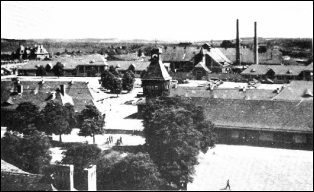
midnight. The Battalion had been
assigned to barracks here which formerly housed a German Artillery unit and was
known as Metzer Kaserne. The name was
more appropriate than the original occupants knew for the whole place was a
mess. The air corps boys who had taken
care of the nearby glass factory had graciously spared most of the camp buildings,
but shrapnel and concussion had worked havoc with the roofs and windows. The Germans in their haste to depart had
left things in a turmoil and the first wave of infantry which took and looted
the place had not improved matters. But
the advance party had worked a small miracle and accommodations were already
far better than they had been throughout most of the war.
The
tankers at once set about making the place livable. Civilian labor was secured for fixing the windows, shingling the
roofs, carting away the rubble and trash, scrubbing the floors, and denazifying
the walls of the more radical decorations.
Among the jumbled mass of junk in the surrounding warehouses sufficient
chinaware and silver was found and soon a full blown Battalion Mess was in
operation, with cooks from all companies and Kraut KPs. An elaborate system of underground wiring
connecting all nearby camps was discovered and repaired and eventually a
switchboard was put in operation, thereby eliminating all the unsightly wires
which had been strung tree to tree in combat fashion when the place was first
occupied. Mudholes were filled and
graveled over – the fag hungry civilians took care of policing up so that the
men of “Old Blood and Guts” were thus relieved of mud and butts and could turn
their attention to more interesting pursuits.
Volleyball courts and horseshoe pits sprang into being all over the
place. Softball teams were organized in
each Company and round robin games were a constant and popular attraction. A swimming meet was scheduled for “Sunday”
but was postponed from “Sunday” to “Sunday” and never held. A track meet finally was run off.
Other
improvements came in rapid order. A
sand floored training barn was cleaned and converted into a movie theater. Soon a stage was added and served for the
production of the elaborate “Anything Goes” USO Show. By the time the excellent “Hubba Hubba” show came the floor had
been cemented. In no time at all the
old cavalrymen had acquired a few horses and the sport became so popular that
the stable soon housed some 40 nags and riding became one of the main sources
of entertainment. Part of the motor
park was fenced off for a training ground and a horse show was held with jumps
and stunts, more to the enjoyment of the spectators than to the participants
who spilled their dignity freely. After
an evening of riding the men would frequently go up to the “Beer Tank” for a
friendly beer or coke. This was
strictly a 712th affair, built from scratch in an empty warehouse room and
decorated with drawings and photographs made by members of the Battalion. Here the Companies held parties with music
by the 712th Downbeats. The latter
outfit was constantly in demand playing dinner music in the Mess Hall and
Officers Mess, accompanying many of the entertainers at the Opera House, and
giving out with jive for dances and impromptu get-togethers.
A
Tailor Shop was established with three pressing machines and civilian
seamstresses who did pressing and alterations first for a fee and then for
free, to keep the tankers looking sharp for guard and fraternizing. That old Army institution the PX got off to
a slow start because of the delay in the shipment of supplies but it gradually
got in gear and toward the end was getting a few such luxuries as wrist watches
and kodak films. A Battalion Dark Room
was set up and furnished with excellent equipment. It was forced to curtail activities sharply on account of the shortage
of film so that much of the developing work was done in town, although instruction
classes in such were held frequently.
Other classes soon commenced.
The Opportunity Course was carried through for those who had not had
much civilian education. German
Language Classes were held three days a week to supplement the work of “Private
tutors” in AMBERG. And several of the
more fortunate were sent to various schools in France and England.
Most
popular of all the I & E projects were the sightseeing tours. The Italy trip, including AUGSBURG,
OBERAMMERGAU, GARMISCH-PARTENKIRCHEN, INNSBRUCK, BRENNER PASS, BODENSEE, ULM
and NUREMBURG, was the most interesting until it had to be curtailed due to
difficulties in crossing the French zone of occupation. The BERCHTESGADEN trip included visits to such
famous places as MUNICH, FREISING, CHIEMSEE, where Mad Ludwig had his fantastic
castle, BAD REICHENHALL, KONIGSSEE, the Eagle’s Nest, SALZBURG, LINZ, PASSEAU
and REGENSBURG. That trip, with slight
variations, was operated every week during the latter part of the stay. Two other trips, one to PILSEN and one into
Switzerland, were inaugurated near the last.
Besides the conducted tours there were individual furloughs to PARIS,
LONDON and the RIVI ERA. For those not
lucky enough to draw one of the fancy furloughs and not interested in the conducted
tours there was still opportunity for fun and relaxation in the hunting and
fishing trips to the nearby lodge.
Life
wasn’t all play. The Camp was primarily
a military establishment. Tanks require
a lot of work, even when they are not running regularly and there were
persistent rumors that they would be turned into Ordnance at any time, so they
had to be kept in tip-top shape.
Morning on a typical day would find the motor pool and maintenance shops
a beehive of activity; a roar and a blue cloud of smoke from an engine tuning
up, three men on a rammer staff swabbing a gun tube, a crewman using a grease
gun on the suspension system, and a goldbrick asleep in the Bog seat. Over at the gas dump a truck would be
gassing up while the dispatcher checked the trip ticket. At the stables several attendants would be
grooming the horses while some supermen employees “policed up” behind
them. Back at the barracks a gang lines
up for early chow preparatory to going on AMBERG Guard. Chow over the relief loads up while the
truck driver impatiently toots for some last minute Joe. Afternoons meant organized athletics,
swimming trips and bunk fatigue.
Swimming at first could be enjoyed in the Lake about 3 Km. east of the
Camp, or in the pool in Amberg. But
toward the last the water became rather bad in both places and the boys came up
with another answer. Back of the Mess
Hall there was a large concrete water reservoir which through the efforts of
the Fire House Crew was converted into a respectable pool. The Fire House boys also put the big tower
clock back into operation, besides keeping their fire equipment in inspection
order.
The
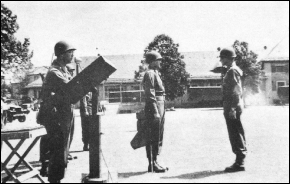
last scheduled formation for the day was Retreat which single Companies stood
in rotation with a weekly Battalion Retreat Parade at which awards were
presented. It was at one of the first
of these formations that Brig. Gen’l. Joseph M. Tully presented the standard to
the Battalion and shortly thereafter the camp was named “Camp George B. Randolph”
in honor of the late Battalion Commander who had given his life in action on 9
January 1945. In honor of these
occasions the Battalion newspaper “Tank-Tracks” was born and it continued to
make its appearance for 12 successive weeks.
A
history of the 712th would he incomplete without a page on AMBERG. This little Bavarian town had not been hard
hit by the war and retains much of its old world charm, With narrow, crooked
streets, tiny dark alleys, an ancient moat and wall, battlements and arched gates
at every entrance. As the personnel of
the AMBERG GUARD the tankers saw the town from the Duty side as conquerors and
governors; directing traffic, halting and questioning suspicious persons,
listening to the varied complaints of civilians and DPs, and shivering through
the long, gray hours on the first shift from 0100 to 0500. As soldiers with considerable free time they
saw the town from the pleasure side.
The long, shady promenade around the Stadtmauer or City Wall, the quiet
parks with convenient benches, the friendly frauleins everywhere, and the
beaucoup kinder who can smell gum or candy a mile away. A completely modern Movie Theater had
everything but a place for your best girl.
Beer was plentiful but none too good.
And toward the end the Red Cross took over the EM Club with their menu
of mud and sinkers.
It
is difficult to tell just when the breakup began. All during the later part of combat men had gone home on rotation
furloughs. Then after the point system
was instituted they began to go in small bunches, and when the transportation
system got into high gear several large groups took leave. But the Battalion was still essentially the
712th when on the memorable Sunday noon Col. Kedrovsky broke the news in the
Mess Hall. It appeared as though the
men who had worked and fought together would go back home together. But the highly impersonal point system
stepped in and separated friend from friend.
Low pointers went to the 2nd Cav., middle pointers to 90th Recon. and
315th Eng., while the high pointers – above 65 – stayed. The redeployment took place on 11 Sept.
1945. The 712th was still a Tank
Battalion on paper, but the 712th of FORKT
DE MONT CASTRE, FALAISE GAP, MAISIERES, METZ, DILLINGEN, OBERWAMPACH, THE
SIEGFRIED LINE, and CZECHOSLOVAKIA was a thing of the past. The “best tank battalion in the U. S. Army”
that the Boche could hurt but never whip, an outfit that never retreated in the
face of the enemy – broken up by the point system.