


The crossing was forced in a pouring rain, however, across the racing, yellow Moselle. Further
trouble in the form of deep mud on the far bank was encountered. The river was now so high that the
enemy mine fields were covered over with water. Some assault craft were carried as far as 1000 yards
downstream from the intended landing sites. The Moselle, rather than the enemy, became the more
formidable foe. The river, by noon, had swelled to 800 yards in width. More and more boats were lost.
The six battalions of infantry across the river made progress but were fighting only with hand-carried
weapons.
The assault waves drove ahead in spite of all difficulties and charged up the high ground toward
Fort Koenigsmacher. The assault was carried on with such speed the infantry-engineer teams ripped
through the wide bands barbed wire surrounding the outworks of the fort and reacheb the open trench
system before the first alarm was sounded by the enemy sentries.
The Germans were taken completely by surprise. Thinking that the Americans could never force
a crossing of the Moselle at flood stage, they had developed a sense of security. It was another instance
of the "Ghost Corps" tactics of striking where least expected. The Germans, fighting skillfully, but as
usual by the book, were stunned at the daring of the maneuver.
The first waves drove the German outposts into their underground fortifications seized the
trenches; but with typical Teutonic ingenuity, the enemy had the trenches zeroed in, and mortar fire
began to fall accurately into the trenches themselves. In some places machine guns were able to pour
enfilading fire down the length of the trench system. The heavier 100 mm batteries of Koenigsmacher
could not be brought to bear because of the closeness of the attackers.
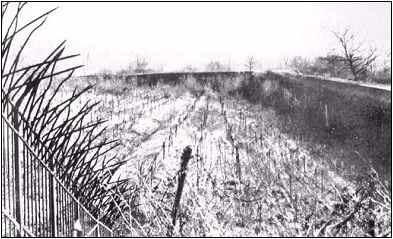
Part of the fortification and obstacles at the entrance to Fort Koenigsmacher
At the end of the first day's activities the 90th Infantry Division hadn’t moved eight battalions of
infantry across the flooded river, penetrated to a depth of 2 miles without armor and support, overrun
seven towns, penetrated a Metz type fort, and captured 200 prisoners. The initial bridgehead had been
secured.
The attack continued against the armored observation posts from which the deadly mortar fire
was being directed against the assault troops. The engineers came to the fort during this phase, blowing
 |
 |
 |