


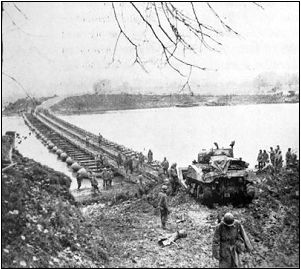
Throughout the night of the 12th of November, ferrying activity and bridging operations
continued. A smoke generator company of a chemical mortar Battalion screened the Cattenom site
proper.
Malling bridgehead much needed and rapid
passage for heavy armor into Metz.
The Moselle was receding rapidly and in doing so uncovered extensive minefields the Germans
had planted along the river banks. Moving these submerged mines consumed five valuable hours and
many other extensive minefields were encountered throughout the bridgehead area.
During the afternoon, the sweating engineers of XX Corps that completed a bridge over the
Moselle at Cattenom . The steady advances of the bridgehead troops had placed them out of range of the
lighter field artillery battalions, and a bridge was necessary for close support of the assault teams knifing
into the forts and fortified towns east of the river. Under the Corps Commander’sare urging, work on
the vital span had been carried on night and day in heavy clinging mud and under intense artillery fire.
At 0540 hrs on November the 13th, the first vehicle raced across the completed bridge. The bridgehead
was secure.
A turning point in the entire Metz operations had been reached. The Metz defenses had been
pierced in the north and south, and the strongest and most formidable obstacle, the Moselle River, had
been breached. In the north, the Koenigsmacher bridgehead forces were ready to surge forward and
snap the enemy defenses. The armor was prepared to hurtle behind enemy lines sever the lines of
communication. On the south, General Walker contemplating the action of patrols probing to the north,
decided to turn the 5th Infantry Division directly north on Metz itself. The XX Corps was ready to
exploit its successes and give the coup-de-grace to the fortified region of Metz.
During the fluid action all along the 40 mile front of XX Corps, the Corps Headquarters was
faced with the necessity of adjusting the plan for the reduction of Metz to metes the ever-changing
situation. The master plan, and its broad outlines, called for a classic encirclement of Metz and wide,
sweeping maneuver in order to avoid a slow, costly frontal assault on the strongly defended ring of forts.
 |
 |
 |