


A River Again
The navy had nothing on the 358th Infantry; for river crossings were forever on the schedule and
the assault boat became as familiar as the jeep. At a quarter past four on the morning of the 6th of the
December, the First Battalion with “B” and “C” Companies in the assault crossed the Saar River in the
vicinity of Wallerfangen, Germany, home of Franz von Papen. Farther down the river, the Third
Battalion led by “I” and “L” Companies, scrambled down the steep banks near Oberlimberg, Germany,
quietly loaded into assault boats, and made its way across the Saar. The Second Battalion, crossing after
daylight on the footbridge, faced heavy mortar and machine gun fire from enemy pillboxes commanding
the river line.
“88” Street
Once across the battalions faced the fortified cities of Pachten and Dillingen, bulwarks of the
Siegfried line. The main thoroughfares took on names like “88” street and “Purple Heart Avenue”. It
became a war against steel and concrete. Troops were raked by fire from pillboxes cleverly concealed in
harmless looking barns and shops. Once again supply men and engineers battled against a river. The
Regiment’s supporting tanks and TDs and the guns of the Anti Tank Company, had to be ferried across,
for Jerry’s heavy shelling prevented the construction of a bridge. Supply men pushed supplies of
ammunition and rations across on every type of boat: alligators, ducks, assault boats and storm boats.
Wiremen struggled day and night to maintain communications across the river despite a swift current
and constant shellfire. For sixteen days and nights the battalions hit again and again into the enemy
fortifications. Continuously hammered day after day, the enemy was systematically blown out of one
pill box after another, as all three battalions were employed to clear the major portion of Dillingen.
Rundstedt Strikes
Then one day came the startling news of the great German counteroffensive in the Ardennes.
Where they would strike next no one knew. During the hours of darkness on the 21st of the December
the Division quietly withdrew across the Saar, forsaking its sizable dent in the Siegfried line and moved
to a defensive position in the Saar-Moselle triangle, facing the Siegfried line again. The holidays were
days of patrolling and constant alert for unusual enemy activity.
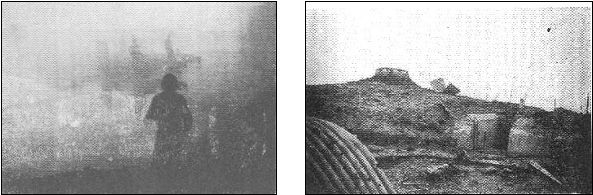
Crossing the Saar in Dillingen, Germany
Concrete observation post and pillbox
knocked out in Dillingen, Germany
 |
 |
 |