


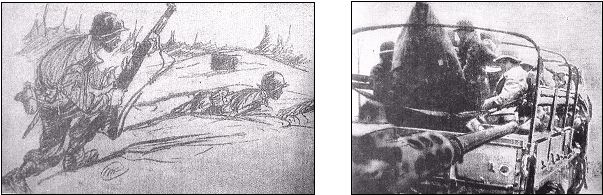
CAMPAIGN OF THE ARDENNES
Bitter cold and heavy snow marked
the movement to the Ardennes
n the 6th, the Division moved northeast into Luxembourg to take its place in the Battle of
the Bulge. The 357th moved into an assembly area near Bavigne and immediately began
making preparations for an attack against the Germans who had just a few short days ago boasted
that they’d be back in Paris soon.
The attack to the north was begun on the 9th and met with immediate success. The
enemy had strong forces in this area, but evidence of their disorganization was apparent. The
advance of the Regiment to the north threatened the supply and withdrawal routes to the
northeast, and as a result, many of the shivering Germans gave up, while others fought on to the
bitter hand. On the 11th, the Regiment took over 1200 prisoners. This was particularly
gratifying as many of them came from the German 5th Paratroop Division, the same outfit
encountered by the 357th at Beau Coudray many months before.
The weather was extremely cold and nearly a foot of snow covered the ground. If the
soldier was careless with his feet, he stood an excellent chance of losing them from “trench foot”
or frostbite. The men were still wearing the same type of leather shoe which they had worn
during the warm summer months, and it simply was not adequate footgear for soldiers who had
to remain exposed to zero weather. Evacuations from exposure were heavy.
By now the Germans were attempting to pull as much of their force as possible out of the
“Bulge”. To protect this withdrawal, the enemy maintained a shell of rear guard defenders
around the diminishing perimeter of his salient. To break through this shell and get at the
retreating columns was now the job.
On the 21st, the Regiment moved into the famous city of Bastogne, Belgium, and
attacked to the northeast the following day, capturing the town of a Asselborn. A crossing of the
Clerf River was forced on the 23rd, and by the 26th, the Regiment had closed up to the Our
O
 |
 |
 |