


for fun, but for the most serious business they had ever undertaken and they knew it. Each one privately
wondered and guessed about D-Day and the part that the 90th might play in that or later landings. The
wide field of speculation was narrowed considerably when on 11 May Company C loaded for combat
and moved from Camp Stanage by motor convoy to Cort-Y-Gol!en near Crickhowell.
Then, on the 13th, Battalion Headquarters, H & S Company, and the Medical Detachment
moved from Berrington Park to Heath Camp at Cardiff. On the same day Companies A and B moved
from Davenport and Kinlet to Camp Bulwark near Chepstow. All elements of the battalion and the
division were now on the southern coast of Wales along the Bristol Channel. It was here that the men
had their first experience with enemy planes and bombs. Although the attack was not directed against
any of the battalion's camps, but at a coastal city several miles away, the exploding bombs sounded as
though they were falling in the next field.
During the two weeks in this so called "transit area" all mess, fatigue and other details were
handled by service troops. Physical conditioning was continued, equipment and supplies were
rechecked, vehicles were waterproofed and the personnel in each company was divided into 3 groups.
The rear echelon group which included the clerical and mess personnel with their equipment moved to a
central division rendezvous point at Bournemouth. The vehicular group consisting of drivers, assistant
drivers and maintenance personnel prepared to carry ashore all supplies and equipment which were to be
needed for the initial operations. Some were to carry explosives, others mine detectors and still others
communication equipment. All of this in addition to full packs and K rations for 3 days. Final practice
in climbing of cargo nets was conducted and still there had been no news announcement that the sea
borne assault on "Festung Europa" had begun. It looked as if the old 90th of Barkeley, Granite and Dix
might be loading up for one the first assault waves.
During the 2nd, 3rd and 4th of June the companies moved to their designated "hards" and loaded
aboard with the vehicular and marching parties of each company on at least two different ships.
Elements of the battalion were on nine individual vessels and there was much wondering whether it
would ever reassemble as the convoy formed up in the Bristol Channel on 5 June 1944.
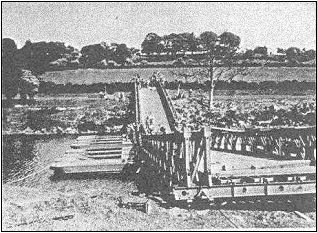
Figure 4-1
 |
 |
 |